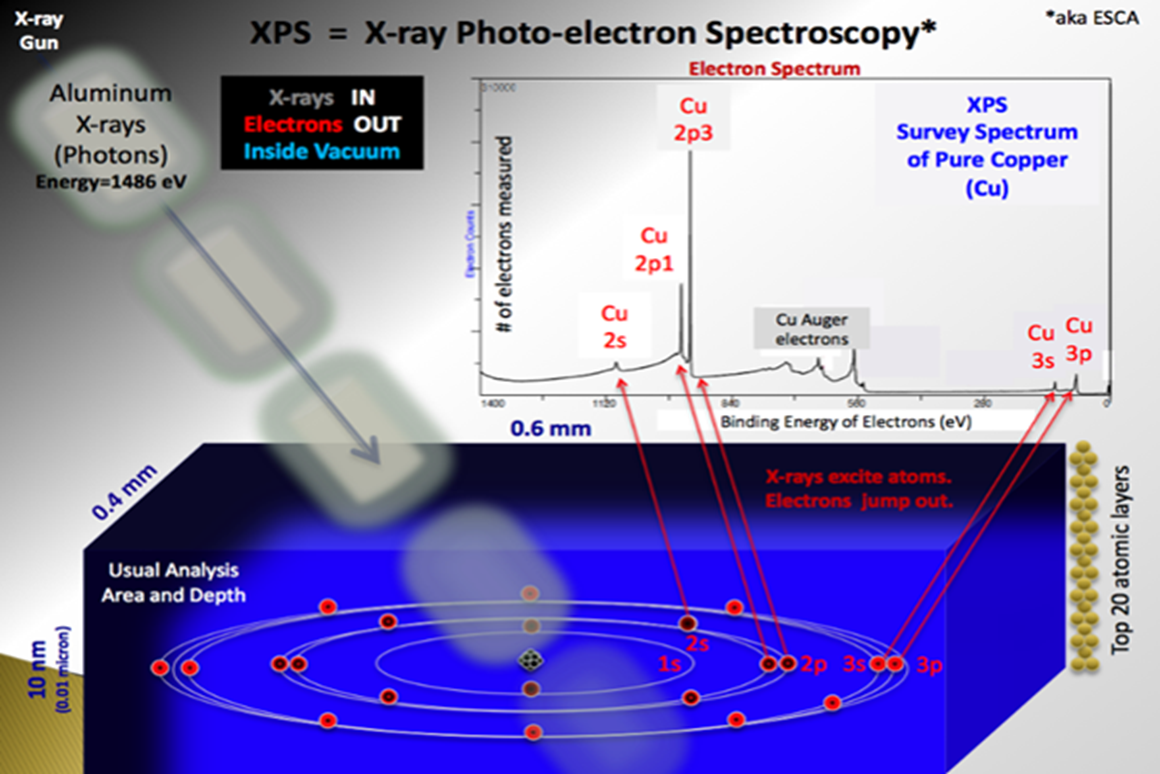


X-ray Photoelectron Spectroscopy (XPS), also known as Electron Spectroscopy for Chemical Analysis (ESCA) , is the most widely used surface analysis technique. It provides detailed information about the elemental composition, chemical states, and electronic structure of a material's surface. Both insulating and conductive materials can be analyzed, with analysis areas ranging from several micrometers to several millimeters.
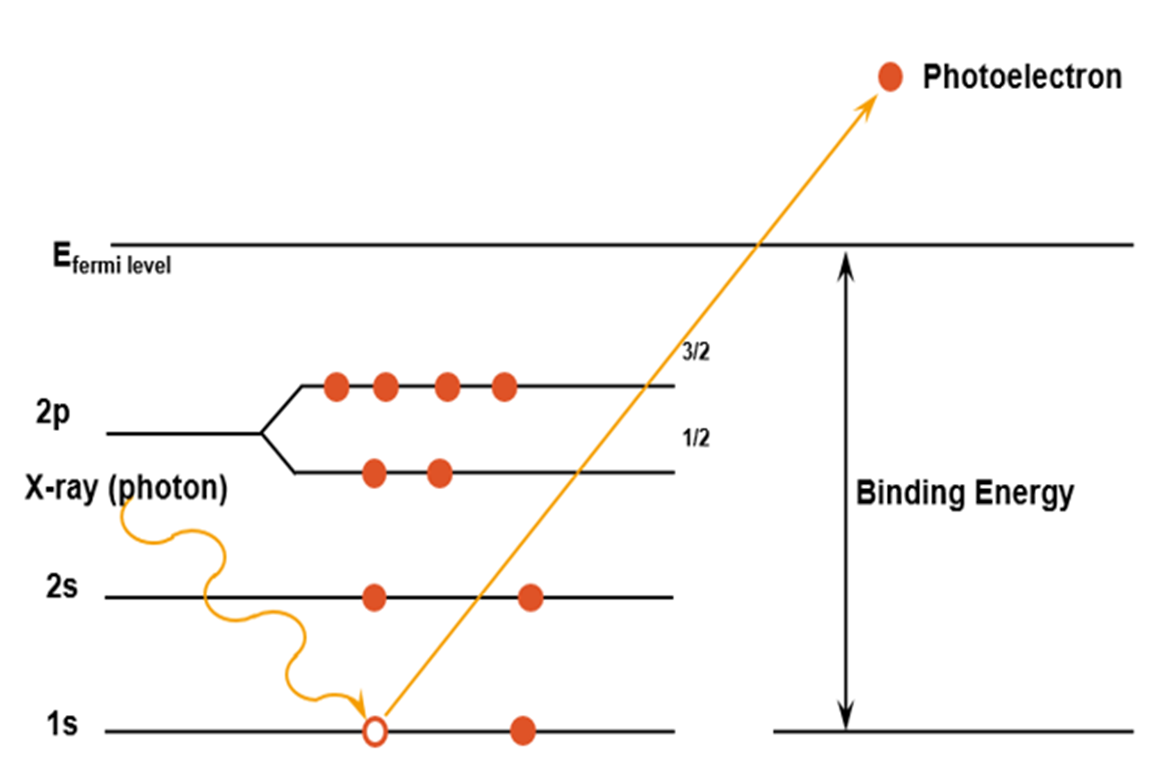
XPS is based on the photoelectric effect, a phenomenon explained by Albert Einstein in 1905. When an X-ray beam strikes a sample surface, it transfers energy to electrons within the atoms. If the energy is sufficient, these electrons are ejected from the material. By measuring the kinetic energy and number of these emitted electrons, XPS reveals what elements are present and how they are chemically bonded.
An incoming X-ray photon with a known energy (hν) strikes a core-level electron in an atom. The electron absorbs the photon's energy and is ejected from the atom with a specific kinetic energy (KE). The relationship is described by the equation:
KE = hν – BE – Φ
-
- KE = Kinetic energy of the ejected electron (measured by the spectrometer)
- hν = Energy of the incoming X-ray photon (known)
- BE = Binding energy of the electron (characteristic of each element and its chemical state)
- Φ = Work function of the spectrometer (a constant)
Because the X-ray energy (hν) is known and the work function (Φ) is constant, the measured kinetic energy (KE) directly gives the binding energy (BE) of the electron. Each element has a unique set of binding energies, acting like a fingerprint. Shifts in binding energy reveal the element's chemical state (e.g., oxide, metal, organic compound).